

Student Guide
Consent Awareness Week
Consent Awareness Week · For students
This one's for you
Consent Awareness Week celebrates student leadership. You know what respect looks and feels like in your classrooms, friendships, teams, group chats, and communities, and your voice can help build a school where everyone belongs. Consent Awareness Week, September 21–25, 2026
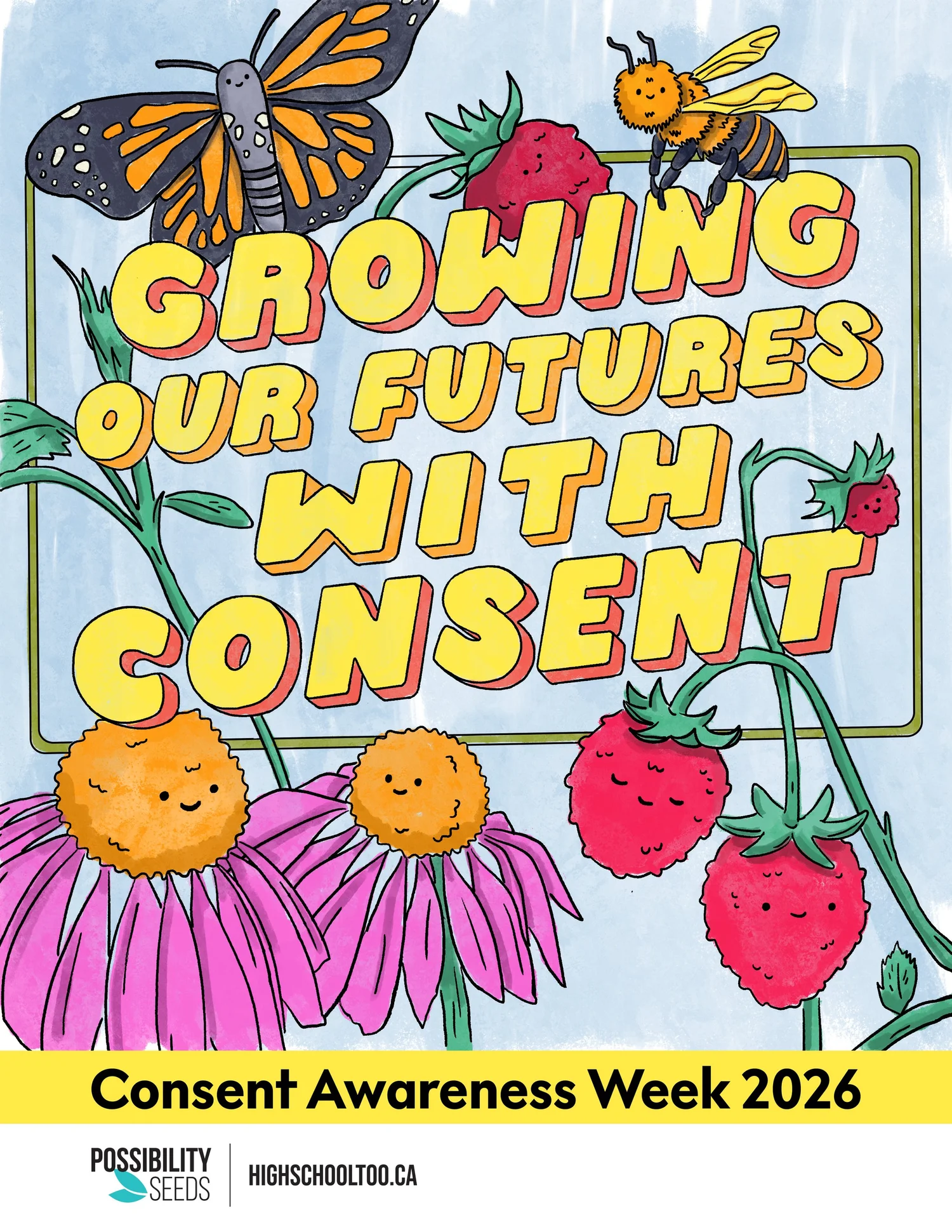
Students have always been at the heart of building safer, more caring schools.
There is no single right way to take part. Choose what feels meaningful and manageable, big or small, on your own or with friends. You never have to share a personal experience to make a difference, and you are not responsible for addressing harm alone. Consent Awareness Week is an invitation to learn, connect, and help build a school where everyone's boundaries, choices, and well-being matter.
A note, just for you
This page is a series of invitations, not homework. Do as much or as little as feels right, and take care of yourself along the way. If any of this brings something up for you, you deserve support, and reaching out to someone you trust is a brave thing to do.
Need support?
If you or someone you know needs support, you do not have to face it alone. Find trusted people, community services, and crisis resources that can help. If someone is in immediate danger, contact emergency services.
Become a Consent Change Leader
Ways to take part
Whether you choose one small activity or organize something school-wide, your voice can help make consent, respect, and support more visible throughout your school.
Watch & talk
Host a screening
Gather a few friends, a club, or a class and watch the BRAVE video together. Afterward, make space for an open conversation: What stood out? What does meaningful support look like? Remind everyone they can take part without sharing personal experiences and may step away at any time. The BRAVE video goes live on September 21.
Make something
Create & share
Make a poster, playlist, zine, TikTok, or collage about what respect and consent mean to you, and share it however you like.
Make a collage
Picture your future with consent
Host a collage activity on your own, with a few friends, or with a whole room. Cut, glue, and imagine what a future built on consent, care, and respect could look like. See how to run it.
Use your voice
Ask for the week at your school
Want your school to mark the week? Talk to a teacher you trust, your student council, or a club. Students starting the conversation is how a lot of this began.
Get on the announcements
Start conversations school-wide
Ask to share a short message or question about consent on your school’s daily announcements during the week, then keep the conversation going in class. Use the messages in the student toolkit or write your own.
Go to city hall
Ask your city to proclaim the week
Ask your mayor and council to officially proclaim Consent Awareness Week. Most cities accept requests from students and community members, and it takes just a letter or an online form. See how to request a proclamation.
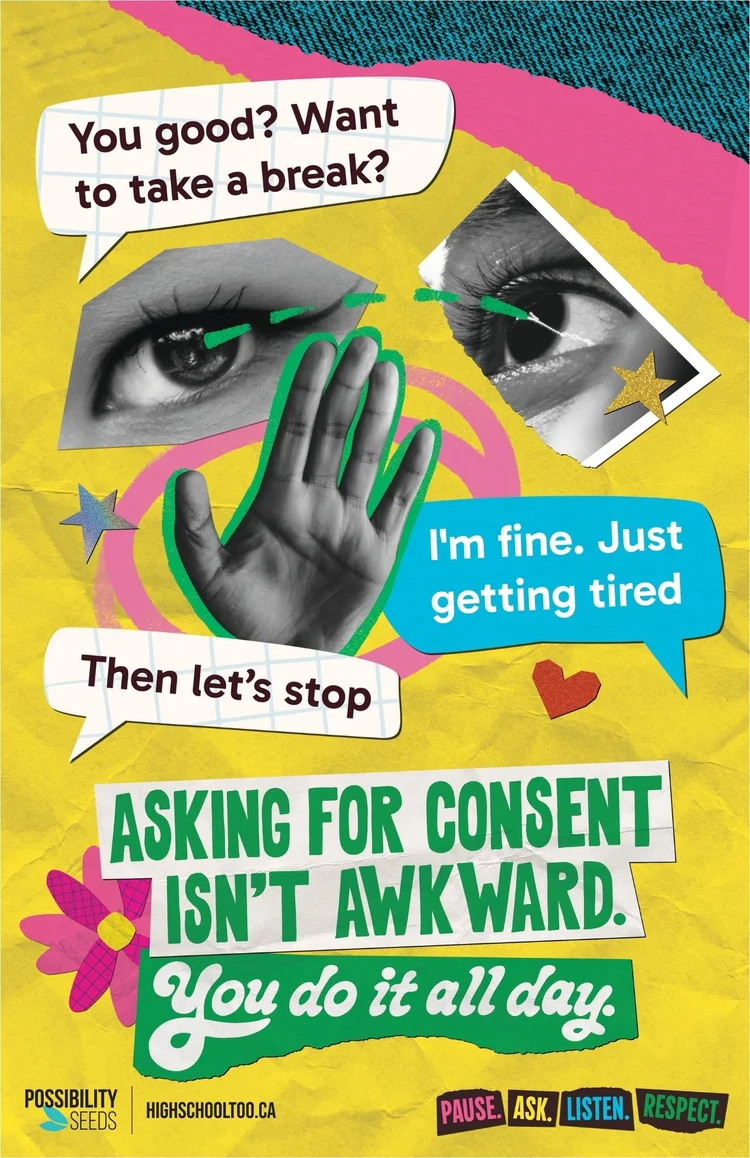
Posters made with students
Download. Print. Put them up.
Consent doesn’t have to be awkward. These posters were co-created with students in the Consent Futures Fellowship and graphic designer Tim Singleton, and show some of the everyday ways we already ask, listen, and respect each other. Put them up around your school, or share them online with the sample posts in the social media toolkit.
Get the posters and social media toolkit
Please keep the Possibility Seeds and High School Too logos on the posters, and credit both when sharing online.
Take it to city hall
Request a Consent Awareness Week proclamation
A proclamation is an official announcement from a government body recognizing a date, occasion, or cause of public importance. It’s one of the most accessible ways to take civic action: most municipalities accept requests directly from students, community members, and organizations. While a proclamation is valid only for the year it’s declared, it can:
Raise awareness
Raise public awareness about consent and gender-based violence prevention.
Bring people together
Mobilize schools, service providers, and community organizations.
Open doors
Create space for local programming, events, and education.
Send a message
Signal that your municipality takes these issues seriously.
Step by step: how to request a proclamation
Not every city or town accepts proclamation requests. Search your municipality’s website for “proclamation request” or “civic proclamation.” Some cities have an online form; others ask for a letter to the Mayor’s office or City Clerk. If you can’t find anything, contact your municipal office and ask about the process.
Whether it’s a form or a letter, include: your name, organization or school (if applicable), and connection to the cause; the name of the observance, Consent Awareness Week; this year’s dates (September 21–25, 2026, the third week of September); proposed wording for the proclamation; and a brief explanation of why consent education matters in your community.
Most municipalities need requests 6 to 10 weeks before the date, so staff have time to review and schedule it.
If you don’t hear back within two to three weeks, send a polite follow-up. If there’s no clear process, your letter itself may help start the conversation.
Templates you can use
Sample letter requesting a proclamation
Subject: Request for Proclamation of Consent Awareness Week
Dear Mayor [Last Name] and Members of Council,
I respectfully request that the City of [Municipality] proclaim the third week of September as Consent Awareness Week.
Consent Awareness Week is a national initiative led by Possibility Seeds and High School Too. It is dedicated to fostering a culture where all people are supported in learning about consent, bodily autonomy, and healthy relationships. By declaring this week, the City of [Municipality] would join a growing movement of communities across Canada committed to preventing gender-based violence and supporting consent education.
[Add 1–2 sentences about your local connection, e.g., your organization, school, or personal commitment to this work.]
I have included suggested wording for the proclamation below and would be glad to provide any additional information or attend a council meeting if helpful.
Thank you for considering this request.
Sincerely,
[Your name, title, contact information]
Sample proclamation wording
WHEREAS consent, bodily autonomy, and healthy relationships are fundamental to the safety and well-being of all people; and
WHEREAS gender-based violence remains a serious issue affecting communities across Canada, including in [Municipality]; and
WHEREAS education, awareness, and dialogue are essential to preventing sexual violence and supporting survivors; and
WHEREAS Consent Awareness Week, observed annually during the third week of September, is a national initiative led by Possibility Seeds and High School Too that provides a moment for communities, schools, and organizations to advance consent education and prevention efforts;
NOW THEREFORE, I, [Mayor’s name], Mayor of the City of [Municipality], do hereby proclaim the third week of September as Consent Awareness Week in [Municipality], and encourage all residents to participate in learning, dialogue, and action toward building a culture of consent.
After your proclamation is approved
Share the news. Post on social media, tag local media, and let community partners know.
Plan programming. Host or co-host events, workshops, or campaigns during the week.
Collaborate. Connect with local schools, service providers, and advocacy groups to amplify the message.
Document it. Add your municipality to the growing list of communities recognizing Consent Awareness Week.
Take the BRAVE Challenge
How to support a friend
If a friend shares that they've experienced harm, you don't need to investigate, solve it, or have all the answers. The BRAVE Model™ is a five-step approach created by Farrah Khan to help you respond with care.
The BRAVE Model™
Begin by listening.
Respect their confidentiality and their choices.
Ask what they need.
Validate their feelings and their experience.
Meet them with warmth, without judgment.
The BRAVE Model™ is the original work of Farrah Khan, used here unadapted with attribution under its CC BY-NC-ND licence. Source: farrahkhan.ca/thebravemodel.
The Tuesday of Consent Awareness Week
We Believe You Day
On the Tuesday of Consent Awareness Week, schools across Canada come together for We Believe You Day. Two ways to take part:
Wear teal
A visible sign
Wear teal, a visible, school-wide sign that in this building, you are believed and you belong.
Learn to step in
Bystander intervention
Commit to learning bystander intervention, including the BRAVE model. Take it, teach it, or bring it to your classroom and community. Many boards have all grades learn bystander intervention, and Grades 9 to 12 learn the BRAVE model.
Common questions
Frequently asked questions for students
Do I have to share a personal experience to take part?
No, never. You can take part fully without sharing anything personal, and you can step away from any activity at any time. Consent Awareness Week is an invitation to learn and connect, not homework, and you are not responsible for addressing harm alone.
How can I take part?
Choose what feels meaningful and manageable: host a screening of the BRAVE video, make a poster or playlist, start a conversation with friends or family, map out where support lives on your school board's website, or ask a teacher or student council to mark the week. Big or small, on your own or with friends, it all counts.
What is the BRAVE model?
Created by Farrah Khan, the BRAVE Model™ is a five-step way to support someone who shares an experience of harm: Begin by listening, Respect their confidentiality and choices, Ask what they need, Validate their feelings and experience, and Empathize (meet them with warmth, without judgment). You can practise it through the BRAVE e-learning.
What if supporting a friend feels like a lot?
Caring for a friend does not mean carrying everything alone. You can speak with a trusted adult or support person without sharing unnecessary details, and you should never promise complete secrecy if you believe someone may be in immediate danger. Looking after yourself matters too.
What is We Believe You Day?
On the Tuesday of Consent Awareness Week, schools across Canada take part in We Believe You Day. You can wear teal as a visible sign that people are believed and belong, and commit to learning bystander intervention, including the BRAVE model.
Where can I find support?
If you or someone you know needs support, you do not have to face it alone. High School Too's support page lists trusted people, community services, and crisis resources. If someone is in immediate danger, contact emergency services.