Consent Awareness Week in schools · A K–12 guide
21–25 September 2026
It takes a community to grow care.
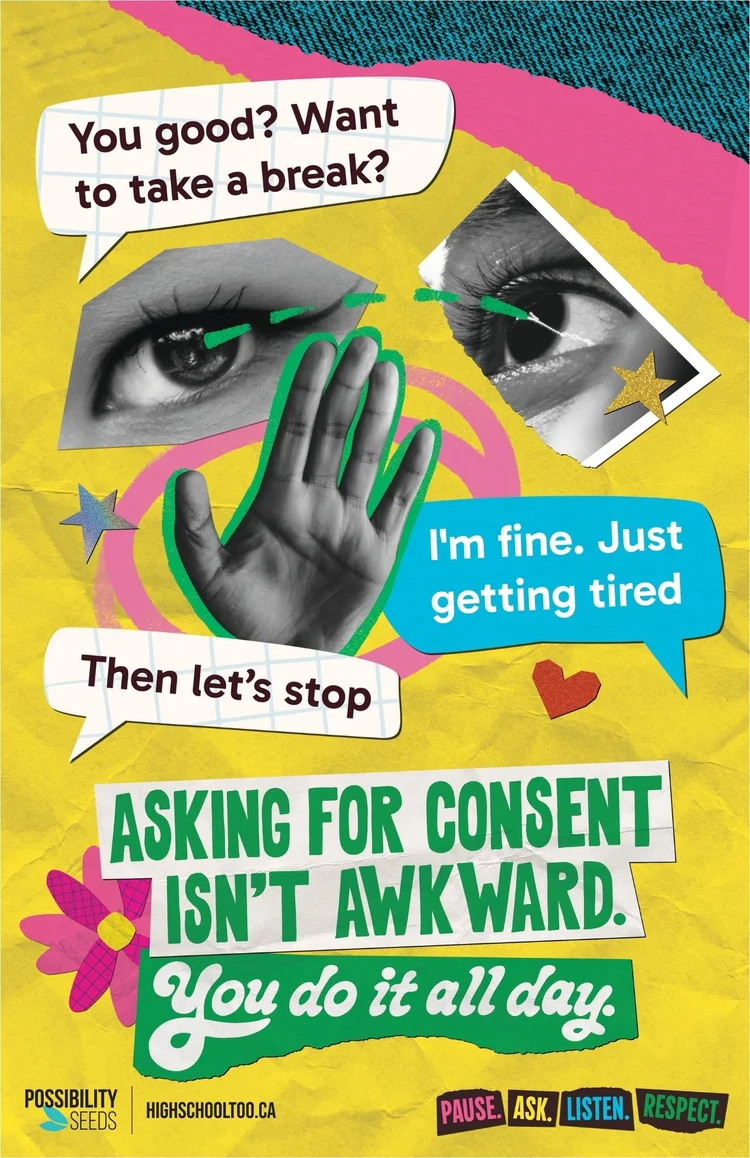
Consent is respect in action: in our schools, we always ask, listen, and look out for each other.
Consent Awareness Week is a national initiative created by Possibility Seeds and High School Too. Join us through age-appropriate activities for every grade, K to 12.
Published by High School Too · Last reviewed · Consent Awareness Week 2026 takes place September 21–25.
A week about respect, care, and community
Every school across Canada has a code of conduct built on respect, dignity, and belonging. Consent Awareness Week, happening every September across Canada, is the moment at the start of every school year where we reflect and build on those values together.
Here's what consent looks like across our schools
In the early years: "Can I sit beside you?" · "You can change your mind at any time." · "That's their toy, let's ask first."
In the middle years: "I hear you saying no, so I'm going to step back." · "What if we work on the homework together?" · "It's okay to feel differently today than you did yesterday."
In high school: "I want to make sure you're still comfortable." · "Before I post that, I'm going to ask first." · "Consent goes both ways, and it's ongoing."
From kindergarten to Grade 12, consent is how we learn and grow together.
Shared language
The same kind words
When every classroom uses the same gentle language, kids carry a steady sense of respect with them, from their first day of school to graduation.
Growing early
Starting young
For little ones, it's about feelings, personal space, and knowing their body is their own. Roots go down early, so respect grows naturally.
Everyone together
Staff, students, families
The week connects the classroom and the kitchen table, so what a child hears at school is waiting for them at home too.
An enthusiastic yes
Freely given, on our own terms, the only yes that counts. On the land, this is reclamation: deciding for ourselves.
Consent is relational
It lives between people, and can always change. We keep listening and stay open to a new answer. Being consulted isn't the same as being free to say no.
No yes means no
Silence or pressure is not consent, and a boundary ignored is consent denied. It's always okay to talk to someone you trust.
The reclamation, recognition, and denial framing is drawn from the Yellowhead Institute (2019). See references.
A gentle idea to hold onto: consent takes more than a voice
This guide grows from The Social Determinants of Consent and Safety (Farrah Khan). Her reminder is this: consent isn't just a moment between two people, it grows in the soil around them. It isn't only about having a voice. It's about feeling safe enough to speak, believing you have the right to be safe, and being able to reach support and services when you need them. Those conditions aren't equal for every child, things like age, racism, or how the world has treated a young person shape them. When we notice that together, and work to change it, we help make sure every child isn't just heard, but safe, believed, and supported. See Sources & references.
Find your starting point
Who are you here as?
This guide has something for everyone in a school community. Choose the way in that fits you, or explore the whole thing.
Why this matters
Not an add-on: it's our code of conduct in action
Respect, care, and community are our school code of conduct in action. Consent and healthy relationships aren't extra. They already live in the curriculum, they're part of our responsibilities as schools, and they build the exact skills young people need for the rest of their lives.
In the curriculum
Already what we teach
Consent, boundaries, and healthy relationships are named expectations in the health and physical education curriculum, from the early grades onward, alongside respect for differences and clear communication. This week simply brings that learning to life.
Our responsibility
Part of a safe school
Education legislation and human rights protections call on schools to provide safe, inclusive, respectful places to learn. Respect, responsibility, and care aren't just nice ideas, they're the foundation of the safe school every student deserves.
Future ready
Durable skills for life
Listening, reading how someone feels, setting and respecting boundaries, and communicating clearly are the durable, human skills that matter in every workplace, friendship, and family. Consent is where young people practise them.
The short version, for anyone who asks
This isn't a new subject or a departure from the curriculum. It's a warm, age-appropriate way to teach what's already expected, respect, healthy relationships, and clear communication, while building the life skills that carry students into their futures. Check your own jurisdiction's curriculum and education legislation for the specific expectations that apply to your schools.
Is consent education part of the curriculum?
Yes. Consent, boundaries, and healthy relationships are named expectations in the health and physical education curriculum from the early grades onward. This week brings that existing learning to life, a school code of conduct in action.
Respect in action
What it actually looks like, day to day
Consent isn't an abstract idea. It's the small, everyday moments already named in most school codes of conduct: treating others with respect, keeping our hands to ourselves, asking before we borrow, and looking out for one another. Here's what that looks like at each age.
Kindergarten to Grade 3
Small moments, big lessons
Asking "can I sit here?" before joining a friend at the carpet. Waiting for a nod before a hug. Checking "can I use your crayon?" instead of just taking it. Hearing "no, not right now" and being okay with it. This is the code of conduct's "treat others with respect" in its very first form.
Grades 4 to 6
Sharing, space, and choices
Asking before borrowing markers, a phone charger, or a snack. Knocking before entering. Checking "is it okay if I share this photo of us?" Noticing when a friend goes quiet in a game and pausing to check in. These everyday choices are exactly what "respect the rights and property of others" means in real life.
Grades 7 to 12
Respect that carries into the world
Asking before tagging or posting someone. Reading the room in a group chat. Respecting a "no" the first time, without pushing. Stepping in, or getting help, when something feels off. This is the code of conduct's stance against harassment and its call to keep our community safe, lived out.
How to make the link explicit
During the week, point back to your school's own code of conduct. When a lesson lands on "ask before you borrow" or "respect a no," name it: "this is what our code means when it says treat each other with respect." Consent becomes the how behind rules students already know, not a separate set of expectations.
What does consent look like day to day at school?
It's the small everyday moments: asking before borrowing a friend's markers, checking before sharing a photo, knocking before entering, and hearing a "no" and respecting it. These are the same behaviours named in most school codes of conduct.
Consent on the land, consent on our bodies
Part of our commitment to reconciliation
Consent isn't only about our bodies. It's also about the land we learn on, and the relationships and responsibilities we hold as a school community. Beginning the year here, with humility and care, is part of our ongoing commitment to reconciliation. Consent means asking before we act. It means listening when someone says no. It means recognizing that everyone has the right to make decisions about their own body, their belongings, and their community. These are values our schools practice every day. They are also at the heart of reconciliation. Canada's Truth and Reconciliation Calls to Action ask us to build education around mutual respect and understanding between all peoples. When we make consent part of who we are, every grade, every school, every September, we are in part answering that call together.
Our code of conduct in action
Consent is what respect, dignity, and belonging look like in practice:
- With each other: asking, listening, and respecting before we act, with friends, classmates, and staff.
- With our bodies and belongings: recognizing that every person has the right to their own physical space and personal property.
- Online: understanding that sharing photos, posts, or personal information without permission is a breach of consent, and a breach of our code.
- With the land: the same respect we show each other extends to the earth, water, plants, and animals we share this place with.
On our bodies
My body, my choice
Each of us has the right to decide what happens to our own body: to be asked, to be heard, and to have our answer respected.
On the land
Honouring consent on the land
Indigenous peoples have the right to give or withhold consent to decisions affecting their lands and territories. This principle is called Free, Prior, and Informed Consent, named in the United Nations Declaration on the Rights of Indigenous Peoples. We hold it with respect, and follow the lead of Indigenous communities in how it's understood.
Why together
Respect, at every scale
Whether it's a body or a territory, the heart is the same: pause, ask, listen, and honour the answer. Holding land and body together helps our students see respect as something that reaches in every direction.
For older students: consent as a spectrum
The green, amber, and red idea at the top of this guide draws on the Yellowhead Institute, which describes consent over land as a spectrum, from denial (consent ignored), to recognition (consulted, but not able to refuse), to reclamation (deciding on one's own terms). It's a powerful way to show that being asked isn't the same as being able to say no, a truth that holds for bodies and land alike.
The framework
Five days, one gentle idea at a time
Each day holds a single idea, shared in words that fit each age. The week opens with a shared language for care, including consent on the land, then makes space to believe and support one another on "We Believe You" Day, before growing through boundaries, relationships, and looking out for each other online. Make each day your own; it's meant to fit alongside what your classrooms already do.
Understanding Consent: A Shared Language
Establish a shared definition of consent, on the land and on our bodies, beginning with Free, Prior, and Informed Consent and then the FRIES model for older students.
K–5 anchor
- Body awareness & feelings
- "Body bubbles" & personal space
- Naming trusted adults
6–12 anchor
- Free, Prior, and Informed Consent (United Nations Declaration on the Rights of Indigenous Peoples) & consent on the land (see below)
- FRIES: Freely given, Reversible, Informed, Enthusiastic, Specific (Planned Parenthood)
- Consent as a life skill in all relationships
Starting with land and body, together
Day 1 holds consent on our bodies alongside consent on the land, as part of our commitment to reconciliation. See the Consent on the land section for how we approach this, learning from Indigenous-created work and collaborating with community where invited.
Supporting Survivors & Each Other · "We Believe You" Day
Believing survivors, responding to a disclosure with care, and looking after ourselves, anchored by the BRAVE model.
K–5 anchor
- Being a good helper
- Telling a trusted adult
- Kindness, empathy & self-care
6–12 anchor
- BRAVE: how to support a friend (see below)
- "Support a friend" video
- Supporting yourself; community & crisis resources
The BRAVE Model©, supporting someone who discloses
Farrah Khan's trauma-informed framework for responding when a friend shares an experience of harm:
- B: Believe what they tell you.
- R: Respect their confidentiality and their choices.
- A: Ask what they need.
- V: Validate their feelings and their experience.
- E: Empathize. Meet them with warmth, without judgment.
The BRAVE Model© is the original work of Farrah Khan (created 1998), used here unadapted with attribution under its CC BY-NC-ND licence. Source: farrahkhan.ca/thebravemodel.
Launching this week
Day 2 is the go-live moment: the new consent e-learning module and toolkit open to schools, and the "support a friend" video premieres as the centrepiece of the day's lesson.
Boundaries: Personal Space & Belongings
Boundaries around bodies and belongings: asking first, every time.
K–5 anchor
- "Ask before you use"
- Seeking & giving permission for touch
- Recognizing physical cues
6–12 anchor
- Boundaries exist everywhere
- Property, space & personal information
- Reading and respecting a "no"
Respectful Relationships & Everyday Consent
Showing and receiving affection, and the principle that no yes means no.
K–5 anchor
- "High-five or hug?" (asking first)
- Safe disclosure of unwanted touch
- Consent in all kinds of relationships
6–12 anchor
- Ongoing consent & check-ins
- Recognizing coercion & pressure
- Healthy vs. unhealthy dynamics
Digital Consent & Online Safety
Consent online, plus clear, step-by-step reporting pathways students asked for.
K–5 anchor
- Asking before sharing photos
- Who to tell and how
- Simple reporting language
6–12 anchor
- Image sharing & social media
- Legal note: sharing explicit images of anyone under 18 is a crime
- Named reporting pathways
Plan for disclosures before you begin
Teaching consent can prompt students to disclose, especially on Day 2. Confirm your board's disclosure and reporting protocol, brief all staff, and have trauma-informed support ready in every building for the full week.
Tiered checklists
Find your role, then your list
The same week looks different from the board office and the classroom. Switch between the two views below.
- Set dates and align with policyChoose the week and map every activity to your code of conduct and provincial or state curriculum expectations.
- Confirm the disclosure protocolReview reporting pathways with student safety and mental health teams; ensure staff know exactly what to do if a student discloses.
- Engage community partners earlyInvite local support and prevention organizations to co-facilitate staff or student sessions.
- Resource every school equitablyDistribute lesson kits, books, and posters so smaller and under-resourced schools are not left behind.
- Build educator capacityRun a train-the-trainer session so each school has a lead who can sustain the work beyond the week.
- Apply an equity lensEnsure materials reflect the full diversity of students, and recognize that some groups face greater barriers to being heard and kept safe.
- Communicate with families in advanceSend a preview letter explaining goals, age-appropriateness, and how families can continue the conversation at home.
- Plan to gather student voiceSet up a simple, anonymous way for students to shape and evaluate the week. Genuine student authority over policy is itself a safety measure, not just a nicety.
- Share the responsibility with careBuilding a culture of consent is something the whole community does together, students, staff, and families. Design the week so young people always have supportive adults alongside them, rather than leaving it to any child to raise a concern on their own.
- Think whole-school, not one assemblyA culture of care grows across everyday moments, in classrooms, hallways, and home conversations, so weave consent through the week rather than relying on a single event (UNGEI whole-school approach).
- Preview every resourceRead lessons, books, and videos in full and apply professional judgment for your grade and community.
- Set a safe classroom agreementEstablish ground rules, opt-out options, and a private way for students to ask questions or seek help.
- Use the shared languageKeep to the board's common definitions so students hear the same message across classrooms.
- Adapt to your grade bandMatch the day's anchor idea to your students' developmental stage using the continuum below.
- Make it accessibleInclude visual cues, plain language, and communication supports so every learner can participate.
- Connect it across subjectsConsent is not only a health topic, link it to literature, digital citizenship, the arts, and civics.
- Know your reporting stepsBe ready to respond calmly and safely to a disclosure and to follow your board's protocol.
For students
Your week, your way
There's no one right way to take part. Pick whatever feels like you, big or small, on your own or with friends. Here are some ideas to spark your own.
Watch & talk
Host a screening
Gather a few friends, a club, or a class and watch the new BRAVE video together, then talk about it. What stood out? What would you do? A snack and a circle of chairs is all you need.
Take the challenge
The BRAVE challenge
Complete the BRAVE e-learning and challenge your friends, your team, or your whole grade to do the same. Learning how to show up for each other is a skill worth having.
Make something
Create & share
Make a poster, a playlist, a zine, a TikTok, or a collage about what respect and consent mean to you, and share it however you like.
Start a conversation
Talk with your people
Bring it up with friends, family, or a group you're part of. Sometimes the most powerful thing is just an honest conversation about how we treat each other.
Look out for each other
Be there for a friend
Learn a few simple ways to support someone who's had a hard time: listen, believe them, ask what they need. You don't have to have all the answers to be a good friend.
Use your voice
Ask for it at your school
Want your school to mark the week? Talk to a teacher you trust, your student council, or a club. Students starting the conversation is how a lot of this began.
We Believe You Day
On the Tuesday of Consent Awareness Week, schools across Canada come together for We Believe You Day. Two ways to take part:
- Wear teal, a visible, school-wide sign that in this building, you are believed and you belong.
- Commit to learn bystander intervention, including the BRAVE model. Take it, teach it, or bring it to your classroom and community. Many school boards commit to having all grades learn bystander intervention, and Grades 9 to 12 learn the BRAVE model.
One day. Every school. A message that lands right at the start of who we are this year.
A note, just for you
These are invitations, not homework. Do as much or as little as feels right, and take care of yourself along the way. If any of this brings something up for you, you deserve support, and reaching out to someone you trust is a brave thing to do.
Developmental continuum
What respect, care, and community look like at each grade
A sample K–8 progression you can adapt. Each grade builds on the last, moving from body awareness toward defining consent and problem-solving real scenarios. More sensitive topics are introduced only when developmentally appropriate.
| Grade | Lesson focus |
|---|---|
| K | Body awareness and physical cues, recognizing sensations and feelings in the body. |
| 1 | What consent looks and sounds like, seeking and giving permission for touch; consent is ongoing. |
| 2 | Identifying safe adults, safe adults listen, support, and never ask a child to keep secrets. |
| 3 | Identifying safe adults, continued, staying safe in different places. |
| 4 | Seeking and giving permission, ongoing consent in all physical interactions. |
| 5 | Proper consent and safe disclosure, identifying consent and a safe adult for inappropriate touch. |
| 6 | Consent in all contexts: consent in everyday interactions and relationships. |
| 7 | Building a definition of consent, giving and receiving consent; naming and managing emotions. |
| 8 | Review and scenarios, healthy relationships, problem-solving, and building solutions. |
Secondary additions (Grades 9–12)
At the secondary level, add a digital consent strand (social media and image sharing), emphasis on ongoing consent and check-ins, mental-health disclosure protocols, and clear legal notes, including that sharing explicit images of anyone under 18 is a criminal offence.
Weaving in "whose 'no' gets heard", age by age
The idea that consent depends on conditions, not just words, can be taught gently and scaled up. In K–5, keep it concrete: everyone's "no" matters, and it isn't fair when someone is ignored or not believed. In 6–8, connect it to peer culture: who gets listened to, who gets teased for speaking up, and how bystanders can change that. In 9–12, name it directly: power, identity, and past experiences can affect whose boundary is respected and whose voice is believed, and that's something we can gently notice and change together, not a personal failing. Caring adults are there to help along the way.
Ready to run
Activities for every grade band
Warm, low-prep ideas you can bring into a classroom, an assembly, or a staff room. Each one notes what it's for and the ages it suits best. Take what fits, leave what doesn't, and make them your own.
K–2 · Personal space
Body bubbles
Each child imagines a "bubble" of space around them. They practise asking "may I come into your bubble?" before a high five or hug, and hear that a "no" or "not right now" is always okay. Builds the earliest language of asking first.
K–2 · Feelings
Yes feeling, no feeling
Using simple faces or a thumbs up and down, children name how different situations feel in their bodies. Connects those inner cues to choices, and gives them words to talk about how they feel with someone they trust.
3–5 · Everyday consent
Ask first, every time
Role-play cards with everyday moments (borrowing a pencil, sharing a photo, a hug goodbye). Students practise asking, and practise hearing and respecting a "no" with grace.
6–8 · Culture
Culture tower
A block-stacking game with green and red markers. Small everyday choices build a stable tower of care; disrespectful ones make it wobble. A hands-on way to see how a community's culture is built choice by choice.
All grades · Make it your own
Consent futures collage
Students imagine a world where everyone feels respected, and make a poster or collage about it. Prompts to spark it: what does consent feel like? What does it look like? What could I do? What could my friends do? It scales to any age, from a drawing in kindergarten to a mixed-media piece in high school. No right answers, just their own vision.
7–12 · Common language
The FRIES check-in
Students test everyday scenarios against FRIES (Freely given, Reversible, Informed, Enthusiastic, Specific) and discuss what a caring "yes" really needs. Credit: Planned Parenthood.
7–12 · Looking out for each other
Support a friend poster
Small groups design a poster on being there for a friend, using simple bystander steps: notice, check in, offer support, tell someone who can help. A creative way to make helping feel doable, not daunting, and to share it with the whole school.
9–12 · Supporting others
Practising BRAVE
In pairs, students practise responding to a friend using BRAVE (Believe, Respect, Ask, Validate, Empathize). Pair with your support-a-friend video. Credit: Farrah Khan; used unadapted with attribution.
9–12 · Digital care
Ask before you share
Scenario discussion on photos, group chats, and reposting, including the clear line that sharing explicit or intimate images of anyone under 18 is against the law. Focuses on respect and looking out for each other online.
Staff · 2 minutes
One kind thing
At a staff meeting, each person shares one small way they already show respect for students' boundaries, and picks one to try this week. No prep, no worksheet. It just gets everyone thinking about care together before the week starts.
Keep it low-stakes, especially in week one
This arrives at the busy start of the school year, so it's meant to be light. There's no test and nothing to hand in. Pick one small thing, a story, a poster, a five-minute chat, and let that be enough. The goal is a warm tone, not a full curriculum. You can always grow it next year.
A gentle note on running these
Have a quick read of each activity first, set a warm, no-pressure tone, and offer a quiet way for any student to step back or take a breather. Talking about feelings and boundaries can bring things up for young people, so let students know there are caring adults around who are glad to listen.
What activities can schools run during the week?
Low-prep options for every grade: body bubbles, a consent futures collage, the FRIES check-in, practising the BRAVE model, and a support-a-friend poster. There's nothing to hand in, one small activity is plenty.
Resources
More ways to explore, together
Books are a lovely way in, and there's more: short videos, visuals for your walls, and trusted organizations who've built wonderful free materials. Preview anything before sharing, and pick what fits your community.
Read together
Ages 0–5
Gentle first books
Will Ladybug Hug? (Hilary Leung) · Don't Hug Doug (Carrie Finison) · Rissy No Kissies (Katey Howes) · Can I Give You a Squish? (Emily Neilson). Sweet stories about asking first and that a "no" is okay.
Ages 4–8
Feelings & boundaries
We Listen to Our Bodies (Lydia Bowers) · Listening to My Body (Gabi Garcia) · Miles Is the Boss of His Body (Samantha Kurtzman-Counter) · C Is for Consent (Eleanor Morrison).
Ages 4–8 · French
Livres tout doux
Anti-Bisous (M. Lenne-Fouquet) · Chevalier Chouette (C. Denise). Warm picture books about affection, choice, and kindness.
Ages 8–12
Friendship & respect
Consent (for Kids!) (Rachel Brian) · Let's Talk About Body Boundaries, Consent and Respect (Jayneen Sanders). Friendly, upbeat guides to everyday consent.
Teens
For older readers
Welcome to Consent (Yumi Stynes & Dr Melissa Kang) · A Quick & Easy Guide to Consent (Isabella Rotman). Clear, warm, and non-preachy.
Teens · French
Pour les ados
#Consentement (S. Deslauriers) · Tes Amours, tes Amitiés et Toi (@annexmp). Approachable reads on friendship, feelings, and respect.
Tips for using books well
Read the book yourself first, choose titles that match your students' ages and your community, and let families know what you will be reading. A story read together, followed by a few open questions, is often the warmest way into these conversations.
Watch & discuss
Tweens & teens
Ask. Listen. Respect.
A short, concrete video for ages 11–16 showing what asking, listening, and respecting look like in real moments. Free from teachconsent.org, and an easy conversation-starter for a class or club.
Your own
The BRAVE video
High School Too's own video on supporting a friend. Screen it, then talk it through using the BRAVE steps. Perfect for "We Believe You" Day.
All ages
Short clips, big talks
A two-minute video is often enough to spark a great discussion. Preview a few, pick one that fits your group, and let the conversation do the rest.
Trusted organizations
Support line
Kids Help Phone
Free, confidential support for young people across Canada, any time. A good resource to name for students, with tips on healthy relationships and boundaries.
Research & tools
PREVNet
A Canadian network with evidence-based resources on healthy relationships, bullying, and violence prevention, built for educators.
Online safety
Canadian Centre for Child Protection
Personal-safety and online-safety programs for schools and families, including NeedHelpNow.ca for youth navigating a shared image.
The national week
Possibility Seeds
Hosts of Consent Awareness Week, with the campaign's own toolkit and up-to-date materials for schools and communities.
Consent basics
Planned Parenthood
Home of the FRIES model and clear, friendly explainers on what consent is and how to talk about it.
Posters & visuals
Make your walls talk
Simple posters, "ask first," "boundaries everywhere," "green means yes", keep the message visible all week. Create your own, or adapt a set for your halls.
Indigenous-led
Native Youth Sexual Health Network
An organization by and for Indigenous youth, whose teachings on consent, "being good relatives," and the land-and-body connection shaped this guide. A place to learn from work Indigenous communities have already shared.
Where can families and schools find consent resources?
This guide includes a K to 12 reading list, short videos such as the Ask, Listen, Respect video, and trusted organizations including Kids Help Phone, PREVNet, the Canadian Centre for Child Protection, Possibility Seeds, and Planned Parenthood.
Beyond the classroom
Growing this at home, together
Children learn the most when the same warmth surrounds them at school and at home. A short, welcoming session for parents and caregivers, offered in person and online, gives families simple, everyday ways to keep the conversation going, no expertise needed, just care.
Framework
Shared language at home
Introduce families to the same consent model students learn, so conversations line up across school and home.
Response
If a child discloses
Simple guidance on listening, responding safely, and connecting a young person to support.
Access
Remove barriers
Offer childcare, virtual options, and translated materials so more families can take part.
Make the ask concrete
End the family session with a few discussion questions for home and a short, curated list of local support services and reputable online resources.
How can families support consent at home?
Use the same language children hear at school, model asking before touching or borrowing, respond calmly if a child shares something difficult, and keep conversations open and everyday. No special expertise is needed, just care.
Ready to send
Letters you can borrow
Three short, warm letters an administrator can copy, adjust, and send: one for families, one for the wider community, and one for educators. Swap in your school's name and details. Tap "Copy" to take the words with you.
For families
Dear families,
As the school year begins, our school is taking part in Consent Awareness Week, a national initiative held every year in the third week of September. It's a gentle, age-appropriate week about something simple and important: respect, care, and how we treat one another.
For our youngest students, this looks like talking about feelings, personal space, and knowing their body is their own. For older students, it grows into conversations about healthy friendships, boundaries, and looking out for each other, in person and online. Nothing about the week is high-pressure, and there's nothing your child needs to prepare.
You are your child's first and most trusted teacher, and these conversations land best when they continue at home. We'll share a few simple questions you can ask around the dinner table, and you're always welcome to reach out with questions.
With warmth,
[Name], [Title], [School]
For the community
To our community,
This September, our school joins schools and organizations across the country in recognizing Consent Awareness Week, a national initiative created by Possibility Seeds and High School Too. It's a shared moment to talk about consent as a cornerstone of all our relationships, at home, at school, at work, and in our neighbourhoods.
Building a culture of care isn't the work of one classroom or one week. It grows when a whole community leans in together. We invite local partners, families, and neighbours to help us nurture spaces where everyone feels respected and heard.
If your organization would like to take part, mark the week, or simply learn alongside us, we would love to hear from you.
In partnership,
[Name], [Title], [School]
For educators
Dear colleagues,
The week of September 21 is Consent Awareness Week, and I'm inviting each of us to bring one small, warm moment of it into our classrooms. This isn't a new unit or an add-on to plan for. It's a chance, right at the start of the year, to set a tone of respect and care that carries through everything else we do.
You'll find ready-to-run activities and a reading list to choose from, scaled for every grade. Pick one thing that feels right for your students, a story, a poster, a five-minute conversation, and let that be enough. Please take a moment to read anything through beforehand, and know that our support team is here if a student needs a caring ear.
Thank you for the care you bring to our students every day. It's the soil all of this grows in.
Warmly,
[Name], [Title]
These are starting points, not scripts. Make them yours, and make sure any details, dates, and support contacts match your school before sending.
Common questions
Frequently asked questions
What is Consent Awareness Week?
A national initiative created by Possibility Seeds with High School Too, held each year during the third week of September (September 21–25 in 2026). It's a chance for schools, families, and communities to talk about consent as part of all our relationships, not just romantic ones.
What does FRIES stand for?
FRIES is a way to remember the five parts of consent: Freely given, Reversible, Informed, Enthusiastic, and Specific. It comes from Planned Parenthood, and it's a friendly tool for talking through what a real "yes" looks like.
What does FPIC stand for?
FPIC stands for Free, Prior, and Informed Consent: the right of Indigenous peoples to give or withhold consent to decisions affecting their lands and territories, named in the United Nations Declaration on the Rights of Indigenous Peoples. For us, learning about it is part of our commitment to reconciliation. We learn from Indigenous-created work, such as the Native Youth Sexual Health Network and the Yellowhead Institute, and collaborate with community where invited.
What is the BRAVE model?
A gentle way to show up for a friend who's had a hard time: Believe, Respect, Ask, Validate, Empathize. The BRAVE Model© was created by Farrah Khan and is used here with attribution.
I'm a student. How can I take part?
However feels right to you. Watch the BRAVE video with friends, take the BRAVE e-learning challenge, make something, start a conversation, or ask a teacher or your student council to mark the week. There's a whole section of ideas above, and none of them are homework.
I'm a parent. What will my child actually be learning?
For younger kids, it's feelings, personal space, and knowing their body is their own. For older students, it grows into friendships, boundaries, and looking out for each other. It's age-appropriate, warm, and about respect, there's nothing your child needs to prepare, and you're always welcome to ask questions.
How much time does this take?
As little or as much as you like. One story, one poster, or one five-minute conversation is plenty, especially at the busy start of the year. You can always grow it next time.
Where can I learn more?
Possibility Seeds hosts the national Consent Awareness Week (possibilityseeds.ca), and you'll find every framework credited in Sources & references below.
Sources & references
Where these ideas come from
Frameworks and resources referenced in this guide are the work of their creators and are credited here. Verify and link your board's approved versions before publishing.
- Consent Awareness Week (Possibility Seeds & High School Too)The national initiative this guide supports, held annually the third week of September (Sept 21–25, 2026). possibilityseeds.ca
- Adapted from HDSB #ConsentEdThe reading list, lesson continuum, and several activities in this guide are adapted from the Halton District School Board's #ConsentEd initiative, with thanks. Confirm and update titles and materials for your own community.
- The Social Determinants of Consent and Safety, by Farrah KhanThe theoretical framework woven through this guide (the "conditions around a yes," the land–body connection, and the shared-responsibility approach) is adapted for a practitioner audience from this work, authored by Farrah Khan. Full academic references below.
- BRAVE Model© by Farrah Khan (1998)Trauma-informed disclosure framework: Believe, Respect, Ask, Validate, Empathize. Original work of Farrah Khan, used unadapted under CC BY-NC-ND. farrahkhan.ca/thebravemodel
- FRIES, from Planned ParenthoodAcronym for the five elements of consent: Freely given, Reversible, Informed, Enthusiastic, Specific. plannedparenthood.org
- Free, Prior, and Informed Consent (United Nations Declaration on the Rights of Indigenous Peoples)The right of Indigenous peoples to give or withhold consent to decisions affecting their lands and territories (UNDRIP, Articles 19 and 32). To learn more, begin with Indigenous-created work such as the Native Youth Sexual Health Network and the Yellowhead Institute, rather than asking local Indigenous staff to prepare new material.
- Curriculum & classroom resourcesSample resources include the Canadian Centre for Child Protection (What's the Deal?, It Is a Big Deal), White Ribbon "Draw the Line," and Ophea Human Development & Sexual Health. Confirm alignment with your provincial curriculum.
- Legal noteIn Canada, creating, possessing, or sharing explicit or intimate images of anyone under 18 is an offence under the Criminal Code. Confirm current wording with your board's legal counsel.
Academic references
From The Social Determinants of Consent and Safety (Farrah Khan). APA style.
Bell, J. (1995). Understanding adultism: A key to developing positive youth–adult relationships. YouthBuild USA.
Centers for Disease Control and Prevention. (2025). About violence prevention. U.S. Department of Health and Human Services. https://www.cdc.gov/violence-prevention/about/
Crenshaw, K. (1989). Demarginalizing the intersection of race and sex: A Black feminist critique of antidiscrimination doctrine, feminist theory, and antiracist politics. University of Chicago Legal Forum, 1989(1), 139–167.
Dahlgren, G. & Whitehead, M. (1991). Policies and strategies to promote social equity in health. Institute for Futures Studies.
Generation Five. (2007). Toward transformative justice: A liberatory approach to child sexual abuse and other forms of intimate and community violence. https://www.generationfive.org
Konsmo, E. M. & Pacheco, A. K. (2016). Violence on the land, violence on our bodies: Building an Indigenous response to environmental violence. Women's Earth Alliance & Native Youth Sexual Health Network. http://landbodydefense.org/
National Inquiry into Missing and Murdered Indigenous Women and Girls. (2019). Reclaiming power and place: The final report of the National Inquiry into Missing and Murdered Indigenous Women and Girls. https://www.mmiwg-ffada.ca/final-report/
Scottish Government. (2024). Preventing and responding to gender-based violence: A whole school framework. https://www.gov.scot
Simpson, L. B. (2014). Land as pedagogy: Nishnaabeg intelligence and rebellious transformation. Decolonization: Indigeneity, Education & Society, 3(3), 1–25.
Simpson, L. B. (2017). As we have always done: Indigenous freedom through radical resistance. University of Minnesota Press.
Together for Girls. (n.d.). A whole school approach to preventing school-related gender-based violence. UN Girls' Education Initiative. https://www.ungei.org
Truth and Reconciliation Commission of Canada. (2015). Honouring the truth, reconciling for the future: Summary of the final report of the Truth and Reconciliation Commission of Canada.
United Nations. (2007). United Nations Declaration on the Rights of Indigenous Peoples. https://www.un.org/development/desa/indigenouspeoples/declaration-on-the-rights-of-indigenous-peoples.html
UN Girls' Education Initiative. (2019). A whole school approach to prevent school-related gender-based violence: Minimum standards and monitoring framework. UNGEI.
World Health Organization. (n.d.). Social determinants of health. https://www.who.int/health-topics/social-determinants-of-health
Yellowhead Institute. (2019). Land back: A Yellowhead Institute red paper. https://redpaper.yellowheadinstitute.org/
Take part this year
Consent Awareness Week runs September 21 to 25, 2026. However you're part of your school community, there's a way in: watch, talk, make something, or bring it to your school.
See ways to take part